
Author: Taylor Zimmerman (Wilcox)
Editor: Jon Zimmerman
Date: November 24, 2026
If a doctor says a treatment is “in Phase 2,” or you see a listing for a Phase 3 clinical trial, those labels can sound like a private code. They are not. The phases of a clinical trial are a set of steps that help researchers answer a few basic questions, in order: Is this treatment reasonably safe? Does it appear to help? Is it better than what we already use? And once it is approved, does it stay safe when many more people take it?
This Research Decoded guide explains Phase 1, 2, 3, and 4 clinical trials in everyday words. It is written for patients, caregivers, and anyone who wants a clearer picture of how new treatments are tested.
Educational information only. This article explains how clinical trial phases work in general. It is not medical advice, and it cannot tell you whether a particular study is right for you or whether you qualify. Please talk with your doctor or care team about any treatment or trial you are considering.
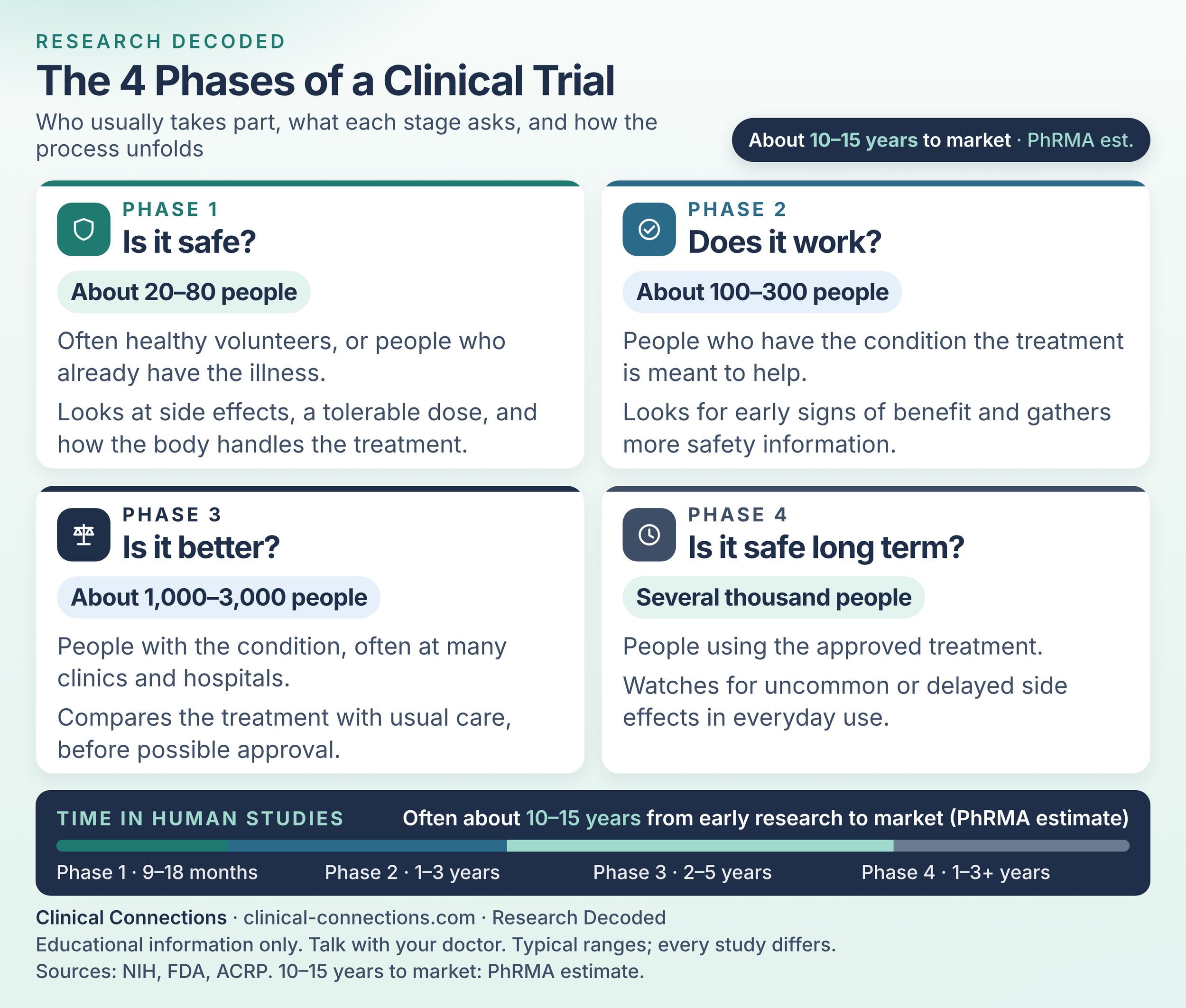
The phases at a glance
| Phase | Who usually takes part | How many people (typical range) | The main question | What researchers study |
|---|---|---|---|---|
| Phase 1 (and optional Phase 0) | Often healthy volunteers, or people who already have the illness when the treatment would be too harsh for a healthy person. | Phase 1: commonly about 20 to 80 people, according to the NIH. Exact numbers vary; some Phase 1 studies are smaller. | Is it safe? What dose can people tolerate? | How the treatment moves through the body, what it does once it is there, side effects, and a workable dose range. |
| Phase 2 | People who have the condition the treatment is meant to help | Commonly about 100 to 300 people, according to the NIH | Does it work? | Early signs of benefit, more safety information, and the dose and schedule to use later |
| Phase 3 | People who have the condition, often at many clinics and hospitals | Commonly about 1,000 to 3,000 people, according to the NIH | Is it better than — or at least as useful and as safe as — current care? | How the new treatment compares with what doctors already use, and whether earlier hints of benefit still hold in a much larger group. The study also records less common side effects and the practical details that later appear in the official label and instructions that come with the medicine. |
| Phase 4 | People who use the approved treatment, sometimes including groups earlier studies covered less often, such as children or older adults | The FDA describes these studies as often including several thousand people who have the condition | Is it safe and useful over the long term? | Uncommon or delayed side effects, everyday use, and how the treatment performs in a wider group of people |
The typical Phase 1, 2, and 3 participant ranges above follow the National Institutes of Health. Other summaries use somewhat different ranges, because the right study size depends on the treatment and the disease. These figures describe typical patterns, not rules for who can join. Each study writes its own eligibility criteria, and only that study's research team can say who qualifies.
Phase 0 and Phase 1: Is it safe?
Phase 1 is usually the first time a new treatment is given to people. The main job is not to prove that it works. The main job is to learn whether it is reasonably safe, what side effects show up, and what dose later studies can use.
Most Phase 1 studies are small. The NIH puts the usual range at about 20 to 80 people. Some trials enroll fewer than that. A federal regulation, 21 CFR 312.21, similarly puts the usual Phase 1 size at 20 to 80 people. Many invite healthy volunteers. When the treatment is meant for cancer, the FDA says researchers usually run Phase 1 in people who already have that cancer.
Researchers start with a low dose and raise it carefully, watching closely at each step. Most Phase 1 studies are run at one research site. On timing, the FDA describes Phase 1 as lasting several months; the Association of Clinical Research Professionals (ACRP) reports a range of about 9 to 18 months.
A brief word about Phase 0
Phase 0 is an optional step, and a Phase 0 study is never a substitute for Phase 1. When researchers do use this step, volunteers receive what FDA guidance calls a “microdose” — under one-hundredth of the amount that animal tests indicate would produce an effect, and less than 100 micrograms. Researchers use that small dose mainly to learn how the medicine moves through the body and leaves it. The study itself is not designed as treatment or as a diagnostic test. On ClinicalTrials.gov, this step is listed as Early Phase 1, the current name for what used to be called Phase 0. Some listings use combined labels, such as Phase 1/Phase 2. Others are marked Not Applicable, including some device or behavior studies that do not use these drug-trial phases.
What “pharmacokinetics” and “pharmacodynamics” mean
You may hear two long words in Phase 1. In everyday language, they ask what your body does to the medicine, and what the medicine does to your body.
Pharmacokinetics is the study of what your body does to the medicine. Researchers look at how it is taken up, where it travels, how it is broken down, and how it leaves.
Pharmacodynamics is the study of what the medicine does to your body — the effects it produces, and how strong those effects are at different doses.
Together, these measurements help the study team choose a dose range for later trials.
Phase 2: Does it work?
If Phase 1 results support moving ahead, the treatment may enter Phase 2. The group is larger, and the participants are people who have the condition the treatment is intended to help.
The NIH puts a common range at about 100 to 300 people. Other overviews describe smaller Phase 2 studies. ACRP estimates that these trials often last one to three years. They are frequently set up so that participants are assigned by chance to the new treatment or to a comparison, and so that some people in the study do not know which one they received.
The central question changes. Researchers still watch for side effects, but they also look for early evidence that the treatment does what it is supposed to do. They refine the dose and the schedule, and they may look at how the new treatment mixes with other medicines. A Phase 2 trial is not usually large enough to give a final answer. It is large enough to decide whether a much bigger study is worth doing.
Phase 3: Is it better?
Phase 3 is the large test that often decides whether the company or group running the research (the sponsor) can ask the U.S. Food and Drug Administration (FDA) to approve the treatment. These studies usually take place at many hospitals and clinics. The NIH says they commonly enroll about 1,000 to 3,000 people who have the condition, though some are smaller or larger. The FDA's patient-facing overview uses a wider range — about 300 to 3,000 people over about one to four years. The same federal regulation that describes Phase 1 also describes Phase 3 studies as usually including several hundred to several thousand people. ACRP estimates that they often run for two to five years.
The main question is comparative: does this treatment work as well as, or better than, the care people already receive? Researchers also keep a close watch on side effects, including problems that were too uncommon to show up clearly in earlier, smaller studies. Depending on the illness, the comparison might be an approved treatment, usual care, or, when it is fair and safe to do so, a placebo (an inactive look-alike). If a study uses a placebo, you are told that before you agree to join (National Cancer Institute).
People are typically assigned to a group by chance, and many Phase 3 trials are set up so that expectations are less likely to color the results. If the findings are strong enough, they become a major part of the package that the FDA reviews.
Phase 4: Is it safe over the long term?
FDA approval does not close the book on testing. Phase 4 studies begin after the FDA has approved the treatment and doctors can prescribe it. Researchers — and the FDA — keep following how it performs when many more people use it, for longer, and in everyday settings.
The FDA describes these studies as often including several thousand people who have the condition. ACRP estimates that a Phase 4 study commonly lasts one to three years, and sometimes longer when a regulator such as the FDA asks for more follow-up. With a much larger group taking the treatment over more time, uncommon or slow-to-appear side effects are more likely to show up. ACRP also notes that these studies may include populations earlier trials did not cover well, such as children and older adults. Safety tracking can continue for as long as the treatment remains in use. A clearer picture of a product's safety can keep taking shape over the months and years it is on the market (FDA).
Why the full journey can take a decade or more
Each phase exists because the last one could not answer every question. A treatment has to show that it is reasonably safe, then that it appears to help, then a clear result in a large comparison, and then continued safety after approval.
The human studies alone can take many years. ACRP estimates about nine to 18 months for Phase 1, one to three years for Phase 2, and two to five years for Phase 3, with Phase 4 adding still more time after approval. The early lab and animal work, the trials themselves, and the FDA review all add time. The drug-industry group PhRMA puts that full path, on average, at 10 to 15 years before a new medicine reaches the market.
Most treatments that enter human testing never reach a pharmacy shelf. In one analysis of programs that entered Phase 1 between 2000 and 2015, 13.8% later received approval (Wong, Siah, and Lo, 2019). An industry-commissioned review of company-sponsored programs from 2011 to 2020 put the likelihood of approval from Phase I at 7.9% (BIO, Informa Pharma Intelligence, and QLS Advisors, 2021). Depending on the years and methods used, that is roughly 1 in 7 to 1 in 13 medicines, which is why people often round it to about 1 in 10. A program can stop at any stage if a treatment looks unsafe or does not help enough. When that happens, the process is doing its job.
The takeaway
The four phases of a clinical trial put safety first. Phase 1 asks whether a treatment can be given to people without unacceptable harm, and at what dose. Phase 2 asks whether it appears to help people who have the condition. Phase 3 asks whether that result holds up — and how the treatment compares — in a much larger group. Phase 4 asks what happens after approval, when the treatment is used in real life.
Joining a trial is always voluntary. Through informed consent, the study team explains the purpose, the risks, and the possible benefits, and you can leave at any time (NIH).
Educational information only — not medical advice. Clinical Connections is a student-led, volunteer nonprofit. We explain clinical research in plain language. We do not give medical advice, screen anyone for eligibility, recommend that anyone join or leave a study, or enroll people in trials. Only a study's research team can decide who can take part, and joining any study is always your choice. Talk with your doctor or care team before making any decision about your health or about a clinical trial. Participant numbers and timelines in this article are typical ranges from public sources. Individual studies can differ.
If you or a loved one is looking at a specific study, you do not have to decode the paperwork on your own. Clinical Connections offers free, plain-language summaries of trials you name, and lists of studies on ClinicalTrials.gov that you may want to ask your doctor about. A student volunteer reads each request and will get back to you within two weeks. A summary or list from us is not a referral and does not mean you qualify. Only the study team can tell you whether you can join, and your doctor can help you decide whether to ask. To request a summary, visit clinical-connections.com or email admin@clinical-connections.com.
Words to know
Clinical trial. A research study in people that tests a treatment, test, or other approach to see whether it is safe and whether it works.
Phase. One of the numbered stages of testing a medicine in people. Each phase answers a different main question.
Early Phase 1 (Phase 0). An optional first look in a very small number of people, using a tiny dose, before a standard Phase 1 study. It is not meant as treatment.
Healthy volunteer. A person who joins a study and does not have the illness the treatment is meant to help.
Dose. How much of a treatment is given, and how often.
Side effect (adverse event). An unwanted effect that shows up during or after treatment. Researchers also use the term adverse event for medical problems they record during a study.
Placebo. An inactive look-alike of the study treatment, used so researchers can compare what happens with and without the active medicine.
Randomization. Assigning people to a study group by chance, rather than by a doctor's or a patient's choice.
Blinding. Keeping the participant, and sometimes the study team, from knowing which treatment a person received, so expectations are less likely to affect the results.
Informed consent. The process of learning a study's purpose, risks, possible benefits, and requirements, then deciding whether to take part. You can change your mind later.
Eligibility criteria. The rules a study uses to decide who can join, based on things such as age, diagnosis, and other health details. Only the study team can apply those rules.
Sponsor. The company, institution, or group that takes responsibility for starting, managing, or paying for a study.
FDA approval. The FDA's decision that a treatment may be sold in the United States for a specific use, after reviewing evidence that it is safe and effective enough for that use.
ClinicalTrials.gov. A U.S. government registry of publicly and privately funded clinical studies. You can look up a trial, see its phase, and read its eligibility criteria. Only the study team can decide who qualifies.
References
- National Institutes of Health. The Basics. NIH Clinical Research Trials and You. https://www.nih.gov/health-information/nih-clinical-research-trials-you/basics
- Association of Clinical Research Professionals. The Four Phases of Clinical Trials. June 2016. https://acrpnet.org/wp-content/uploads/dlm_uploads/2016/10/The-Four-Phases-of-Clinical-Trials_June-2016-1.pdf
- U.S. Food and Drug Administration. Step 3: Clinical Research. https://www.fda.gov/patients/drug-development-process/step-3-clinical-research
- U.S. Food and Drug Administration. Exploratory IND Studies. Guidance for Industry, Investigators, and Reviewers. January 2006. https://www.fda.gov/regulatory-information/search-fda-guidance-documents/exploratory-ind-studies. PDF: https://www.fda.gov/media/72325/download
- PhRMA. From lab to medicine cabinet: Following a medicine’s path to patients. https://phrma.org/blog/from-lab-to-medicine-cabinet-following-a-medicine-s-path-to-patients
- U.S. Food and Drug Administration. 21 CFR 312.21, Phases of an investigation. https://www.ecfr.gov/current/title-21/chapter-I/subchapter-D/part-312/subpart-B/section-312.21
- U.S. Food and Drug Administration. Step 5: FDA Post-Market Drug Safety Monitoring. https://www.fda.gov/patients/drug-development-process/step-5-fda-post-market-drug-safety-monitoring
- National Cancer Institute. How Do Clinical Trials Work? Updated November 8, 2024. https://www.cancer.gov/research/participate/clinical-trials/how-trials-work
- Wong, C. H., Siah, K. W., & Lo, A. W. Estimation of clinical trial success rates and related parameters. Biostatistics. 2019;20(2):273–286. https://doi.org/10.1093/biostatistics/kxx069. PubMed: https://pubmed.ncbi.nlm.nih.gov/29394327/. PMC: https://pmc.ncbi.nlm.nih.gov/articles/PMC6409418/
- BIO, Informa Pharma Intelligence, and QLS Advisors. Clinical Development Success Rates 2011–2020. February 2021. Industry-commissioned analysis. https://go.bio.org/rs/490-EHZ-999/images/ClinicalDevelopmentSuccessRates2011_2020.pdf
- ClinicalTrials.gov. Glossary. https://clinicaltrials.gov/study-basics/glossary
- ClinicalTrials.gov. Learn About Studies. https://clinicaltrials.gov/study-basics/learn-about-studies
- U.S. Food and Drug Administration. 21 CFR Part 50, Protection of Human Subjects (informed consent). https://www.ecfr.gov/current/title-21/chapter-I/subchapter-A/part-50
Further reading
Kandi V, Vadakedath S. Clinical Trials and Clinical Research: A Comprehensive Review. Cureus. 2023;15(2):e35077. https://doi.org/10.7759/cureus.35077. PubMed Central: https://pmc.ncbi.nlm.nih.gov/articles/PMC10023071/. Listed here rather than among the main references because the participant counts, durations, and Phase 0 definition in this article come from the NIH, FDA, ACRP, and other primary sources above.
Keep reading on Research Decoded
- The journey of a drug: what happens before clinical trials
- The questions that matter most: finding the right clinical trial
Get every new post in one email, every other week: sign up for the Research Decoded digest at the bottom of this page. Educational information only, not medical advice.
